1. What Reinforced Garage Slabs Are and Why They Matter
A reinforced garage slab is one of the most critical investments you’ll make for your property. It’s not just a concrete floor—it’s the foundation that supports vehicles, equipment, and heavy loads year-round while resisting Louisiana’s challenging moisture and temperature cycles. When done right, a reinforced slab lasts decades. When done wrong, you’re looking at cracking, settling, and costly repairs within just a few years.
We’ve installed hundreds of garage slabs throughout Lafayette and surrounding areas, and we’ve seen firsthand how the difference between a mediocre contractor and a true professional can mean 20+ extra years of durability. This guide walks you through what makes a reinforced garage slab work, what separates top-tier contractors from the rest, and how to protect your investment.
A reinforced garage slab is a concrete foundation reinforced with steel rebar or wire mesh to distribute loads evenly and prevent cracking under stress. Unlike a basic concrete pad, reinforcement gives the slab tensile strength—the ability to resist bending and pulling forces that occur when vehicles park on it or temperature swings cause the concrete to expand and contract.
Here’s why this matters in Lafayette specifically: our Louisiana climate creates intense pressure on concrete. Summer heat causes expansion, winter cooling causes contraction, and persistent moisture infiltrates cracks and expands when it freezes. Without proper reinforcement, hairline fractures develop within 2-3 years and escalate into structural problems.
A properly reinforced slab handles these stresses without failing. You’ll notice:
- No visible cracking after 5+ years
- Minimal settling or uneven surfaces
- Better load distribution for heavy vehicles or equipment
- Resistance to freeze-thaw cycles
The cost difference between a reinforced slab and a basic one is typically 15-25%, but the durability difference spans an extra 15-20 years. That’s not an upgrade—it’s insurance.
2. The Importance of Proper Soil Preparation and Grading
Most garage slab failures don’t happen because of concrete problems. They happen because of what’s underneath.
We always start with soil analysis and grading. The subgrade (the layer of soil beneath the slab) must be properly compacted, drained, and leveled. If water pools beneath the slab or soil compaction is uneven, the concrete will settle unevenly, and cracks will follow. In Lafayette, where water table and drainage are constant challenges, this step is non-negotiable.
Our process includes:
- Testing soil bearing capacity to ensure it can handle the slab’s weight
- Removing organic material and unstable topsoil
- Compacting the subgrade in 4-6 inch lifts with mechanical equipment
- Installing perimeter and interior drainage to manage water runoff
- Grading to ensure positive drainage away from structures
A contractor who skips soil preparation or rushes this phase is cutting corners where they matter most. We’ve seen competitors skip compaction testing or leave inadequate drainage, and the homeowner pays for it within 18-24 months when the slab begins to crack and settle.
3. Steel Reinforcement Quality and Specifications
The type and placement of reinforcement directly impacts how your slab performs.
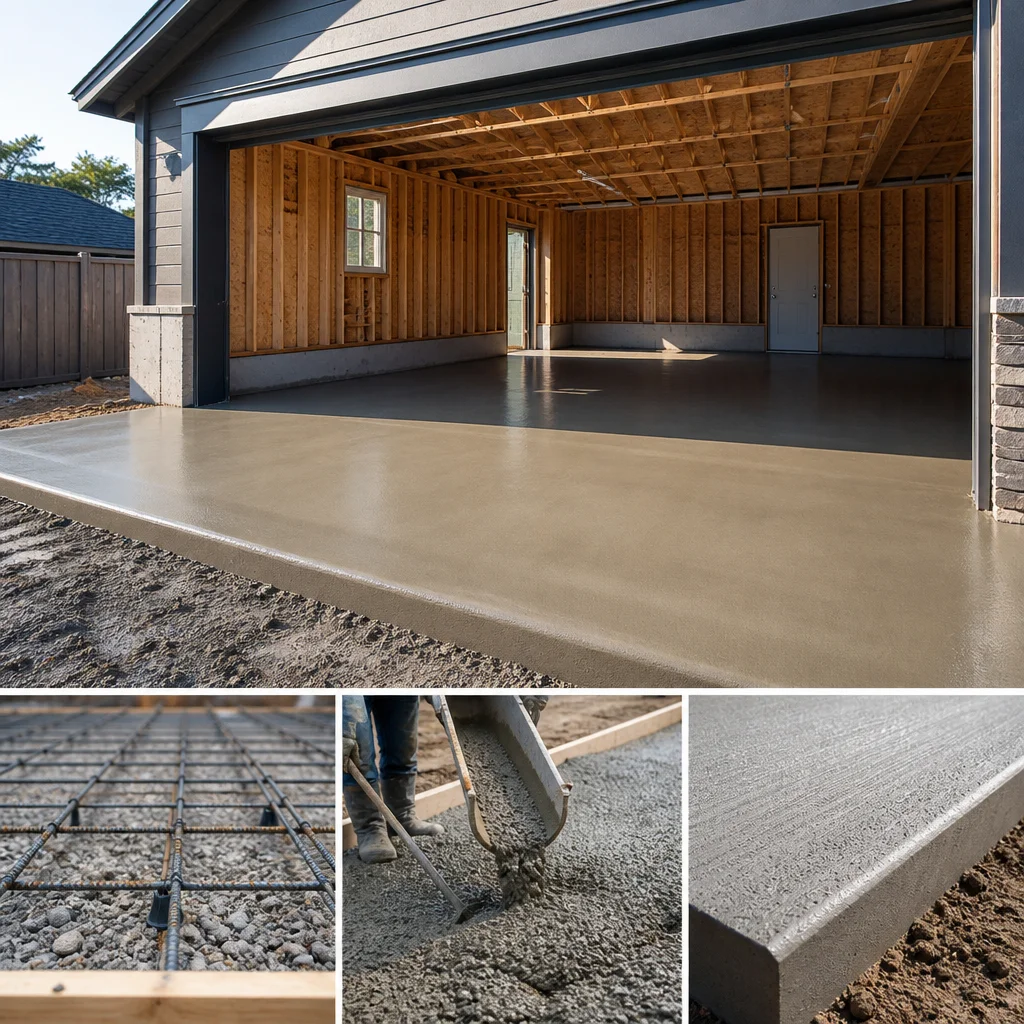
We specify #4 rebar (half-inch diameter) on 12-inch centers, or equivalent wire mesh meeting ACI (American Concrete Institute) standards. The reinforcement must be:
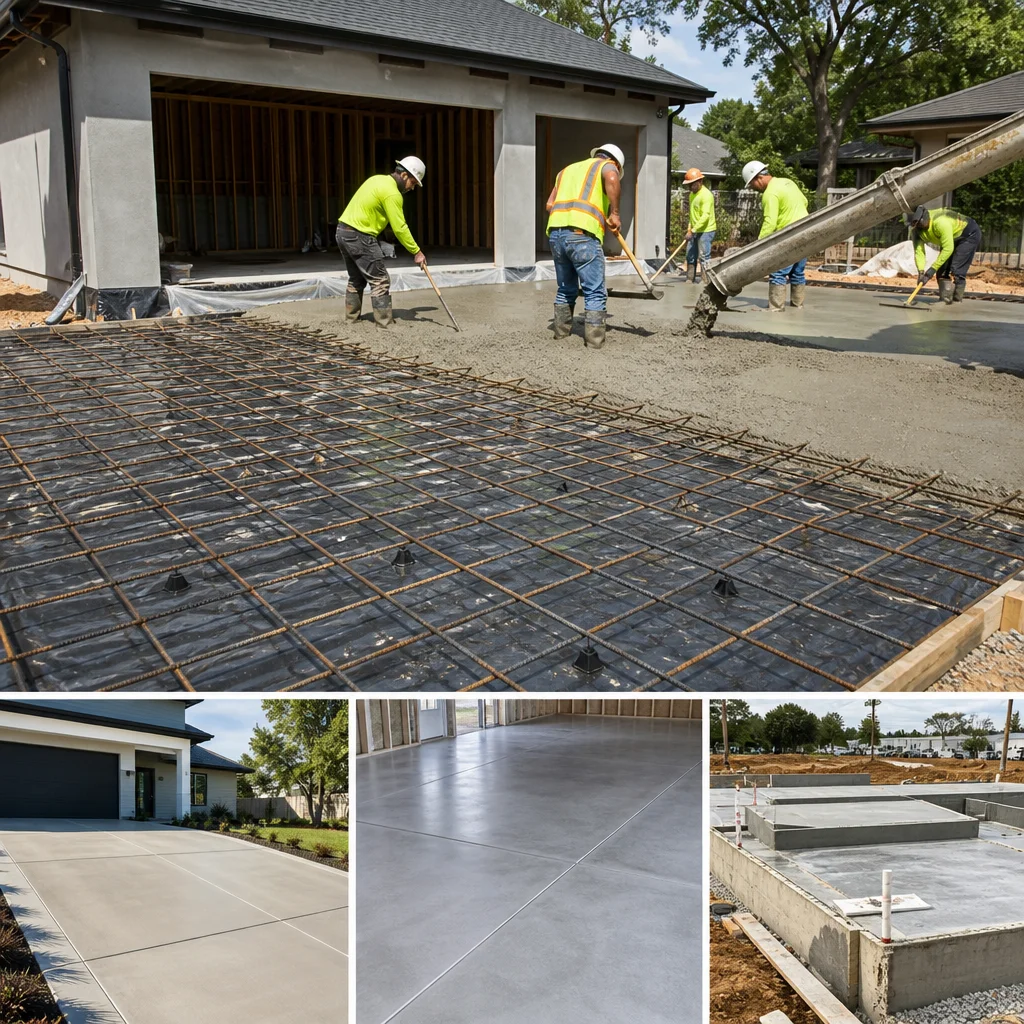
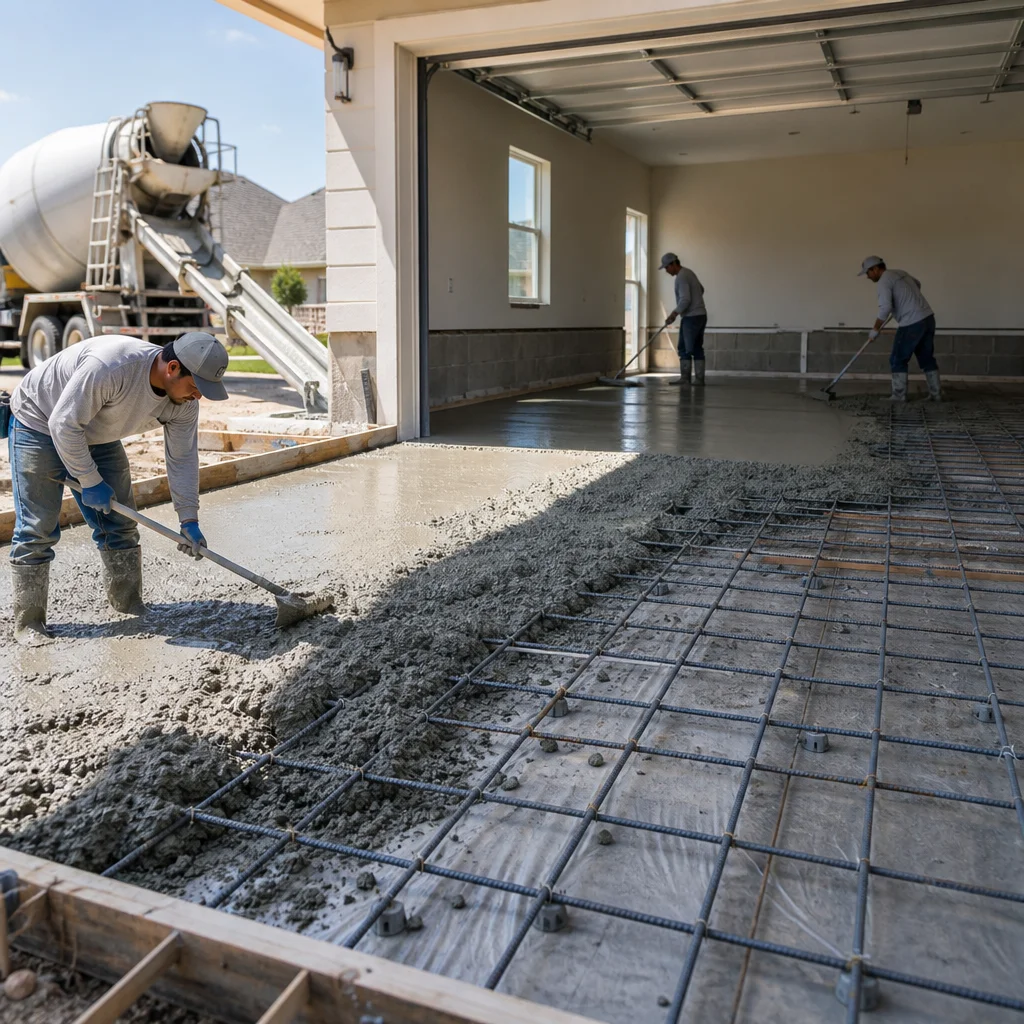
- Positioned in the middle third of the slab depth (typically 2-3 inches up from the subgrade)
- Properly lapped and tied to create a continuous matrix
- Free of rust, oil, or debris that would reduce concrete bond
- Supported on plastic chairs to maintain consistent height
Why does this matter? If rebar sits too low (touching the subgrade), it won’t reinforce the top portion of the slab where tensile stress concentrates. If it sits too high, it defeats the purpose. Placement tolerance is critical.
Many budget contractors use lighter gauge mesh or space it wider to save money. The structural performance difference is dramatic. We’ve tested slabs reinforced with improper mesh specifications, and they crack at loads 30-40% lower than properly reinforced slabs.
Our specs align with ACI 302.1R standards for garage and industrial floors. That’s what you should ask any contractor for: exact reinforcement specifications in writing before work begins.
4. Concrete Mix Design for Maximum Durability
Not all concrete is created equal. The mix design—the precise ratio of cement, aggregates, water, and additives—determines strength, durability, and resistance to freeze-thaw cycles.
For garage slabs in Lafayette, we specify a minimum 4,000 PSI compressive strength concrete with a low water-to-cement ratio (0.45 or lower). We also add:
- Air entrainment (4-7% air content) to resist freeze-thaw damage
- Fly ash or slag cement to improve durability and reduce permeability
- Reinforced aggregate gradation for better load distribution
- Pozzolanic materials to reduce efflorescence and surface scaling
A generic “contractor mix” from a ready-mix supplier won’t include these specifications. We work directly with our ready-mix producer to ensure the truck arriving on-site matches our exact specifications. We test slump, air content, and strength with on-site curing cylinders.
Corners are cut here constantly. Some contractors accept whatever the ready-mix plant delivers, or they water down the mix to improve workability (easier to finish, but catastrophic for durability). We treat mix design like structural engineering, because it is.
5. Professional Installation Techniques That Ensure Longevity
Installation is where knowledge and discipline separate professionals from amateurs.
Our crew follows a strict sequence:
- Moisture barrier installation (6-mil polyethylene or equivalent) to block ground moisture
- Concrete placement in sections, using laser-graded screeds to maintain elevation within 1/8 inch
- Vibration during and after placement to eliminate air pockets that create weak zones
- Finishing passes with power trowels in the direction of traffic flow
- Proper control joint placement every 6-8 feet to direct cracking to predetermined locations
- Curing for 7 days with moisture retained (not air-dried)
The curing step is where we see the most shortcuts. Concrete gains only 70% of its strength in the first 7 days; it needs 28 days to fully cure. Many contractors rush homeowners to use the slab within days. We seal the slab and keep it moist for a full week minimum, then recommend waiting 14 days before heavy traffic.
A slab rushed into use too early will crack prematurely, and no amount of later maintenance fixes it.
6. Why We Stand Out from Other Lafayette Concrete Contractors
We’re not just another concrete company. Our difference is measurable.
We stand out because we combine licensed engineering oversight with hands-on craftsmanship. Every garage slab project includes:
- Geotechnical soil assessment before we quote
- Written specifications for reinforcement, mix design, and installation techniques
- Real-time quality testing during placement
- Photo documentation of critical phases (subgrade prep, reinforcement, placement, finishing)
- A detailed concrete warranty covering settlement, cracking, and durability
- 10-year structural warranty on slabs we install
Our crews are permanent staff, not day laborers hired for each project. They understand our standards and execute them consistently.
We also price transparently. No surprises, no change orders because we “found problems” after digging. We invest time in site assessment upfront so you get an accurate quote the first time.
7. Common Mistakes to Avoid When Installing Garage Slabs
Understanding what goes wrong helps you recognize red flags when evaluating contractors.
Inadequate site preparation: A contractor who doesn’t test soil or skips compaction is gambling with your investment. Insist on seeing soil compaction reports.
Improper reinforcement placement: Ask to see reinforcement specs in writing and verify placement with a metal detector or concrete cover meter during installation.
Mixing concrete on-site or accepting off-spec ready-mix: Generic mixes fail faster. Get mix design documented and verified with on-site testing.
Finishing too quickly: Concrete finished before bleed water disappears or before it’s stiff enough creates weak surface layers. This causes scaling and spalling within 2-3 years.
Insufficient curing time: If a contractor says the slab is ready to drive on after 48 hours, walk away. That’s 5-7 days minimum, and patience pays off in durability.
No expansion joints at perimeter: The slab needs to expand and contract independently from foundation walls. Poor detailing here creates cracking.
Inadequate drainage: A slab without proper drainage is a time bomb. Water pooling beneath or around the slab accelerates failure.
8. Maintenance Tips to Protect Your Investment
Your reinforced garage slab is built to last, but maintenance matters.
Keep it clean and dry: Sweep regularly. Standing water invites algae growth and freeze-thaw damage. Make sure gutters and downspouts direct water away from the slab perimeter.
Seal the surface: We recommend resealing every 2-3 years with a penetrating sealer. This prevents water penetration and extends slab life by 10+ years.
Watch for drainage changes: If water begins pooling around the slab, address grading or drainage immediately. Don’t let it sit.
Repair small cracks early: Hairline cracks (less than 1/8 inch) should be sealed to prevent water infiltration and expansion. We offer affordable crack repair services.
Avoid harsh chemicals: Road salt, de-icing products, and strong acids damage concrete. Rinse the slab after winter salt exposure.
Monitor movement: If you notice new cracking, settling, or large cracks developing, contact us for inspection. Early detection prevents minor issues from becoming structural problems.
A properly installed slab with basic maintenance will serve you 30+ years without major repairs. Neglected slabs deteriorate in half that time, even if installed correctly.
We’ve built our reputation in Lafayette by installing slabs that last decades, backing them with warranties that mean something, and standing behind our work with transparent communication and fair pricing. If you’re evaluating reinforced garage slab contractors, we invite you to contact us for a free estimate and to ask your other candidates the questions raised in this guide. You’ll see the difference immediately.
Frequently Asked Questions (FAQ)
What makes a reinforced garage slab different from a standard concrete slab?
We install reinforced garage slabs with steel reinforcement that prevents cracking and shifting under heavy vehicle loads and stress. Our process includes proper soil preparation, quality steel specifications, and engineered concrete mixes designed specifically for durability in the Lafayette climate. Standard slabs lack this structural reinforcement, which means they’re more prone to failure over time, especially in high-traffic areas.
How do we ensure your garage slab will last for decades?
We combine three critical steps: thorough grading and soil preparation to create a stable foundation, professional-grade steel reinforcement placed at precise depths, and concrete mix designs formulated for maximum durability. Our installation techniques follow industry standards that protect against settling, cracking, and weather damage common to Louisiana properties. We also provide maintenance guidance to help you protect your investment long after installation.
Can we repair an existing garage slab instead of replacing it?
We assess your current slab to determine whether concrete leveling and targeted repairs make sense for your situation. Sometimes a failing slab needs complete replacement to ensure safety and proper foundation support for your garage structure. We’ll provide you with a free no-obligation estimate that outlines our recommendation and pricing for either repair or replacement work.