Why Commercial Slab Settling Threatens Lafayette Properties
Slab settling isn’t a cosmetic issue. When concrete foundations shift, the damage cascades quickly through the entire structure. We’ve seen commercial properties in Lafayette experience foundation cracks that later compromised load-bearing walls, forced businesses to close temporarily for repairs, and triggered insurance complications because settling was classified as “maintenance neglect.”
The financial stakes are substantial. A small settlement crack that costs $500 to address today can become a $15,000 structural repair within two to three years. For commercial property owners, this means potential liability exposure, tenant dissatisfaction, and operational disruptions. Residential homeowners face reduced property values and costly foundation reconstructions that can reach $20,000 or more.
Lafayette’s specific geography makes this problem acute. Our region combines heavy rainfall, high water tables, and expansive soil conditions that naturally promote foundation movement. When moisture levels fluctuate seasonally, soil expands and contracts, pulling the concrete slab with it. This isn’t preventable through willpower or wishful thinking; it requires either proactive intervention or acceptance of future damage.
Action takeaway: Stop assuming small cracks are normal wear. Document any visible settling with photos and dates, then contact a professional for a baseline assessment before the problem worsens.
Understanding Slab Settling in Flood-Prone Environments
Slab settling in flood zones operates differently than in drier climates. The primary culprit is water movement beneath the slab, which destabilizes the soil base through three mechanisms: erosion, consolidation, and differential settlement.
Erosion happens when water finds small gaps or poorly compacted base materials and washes soil away, creating voids beneath the concrete. Consolidation occurs when water-saturated soil becomes overloaded and compresses, causing uneven sinking. Differential settlement is the worst scenario: different parts of your slab sink at different rates, creating stress that cracks the concrete and breaks apart the structure.
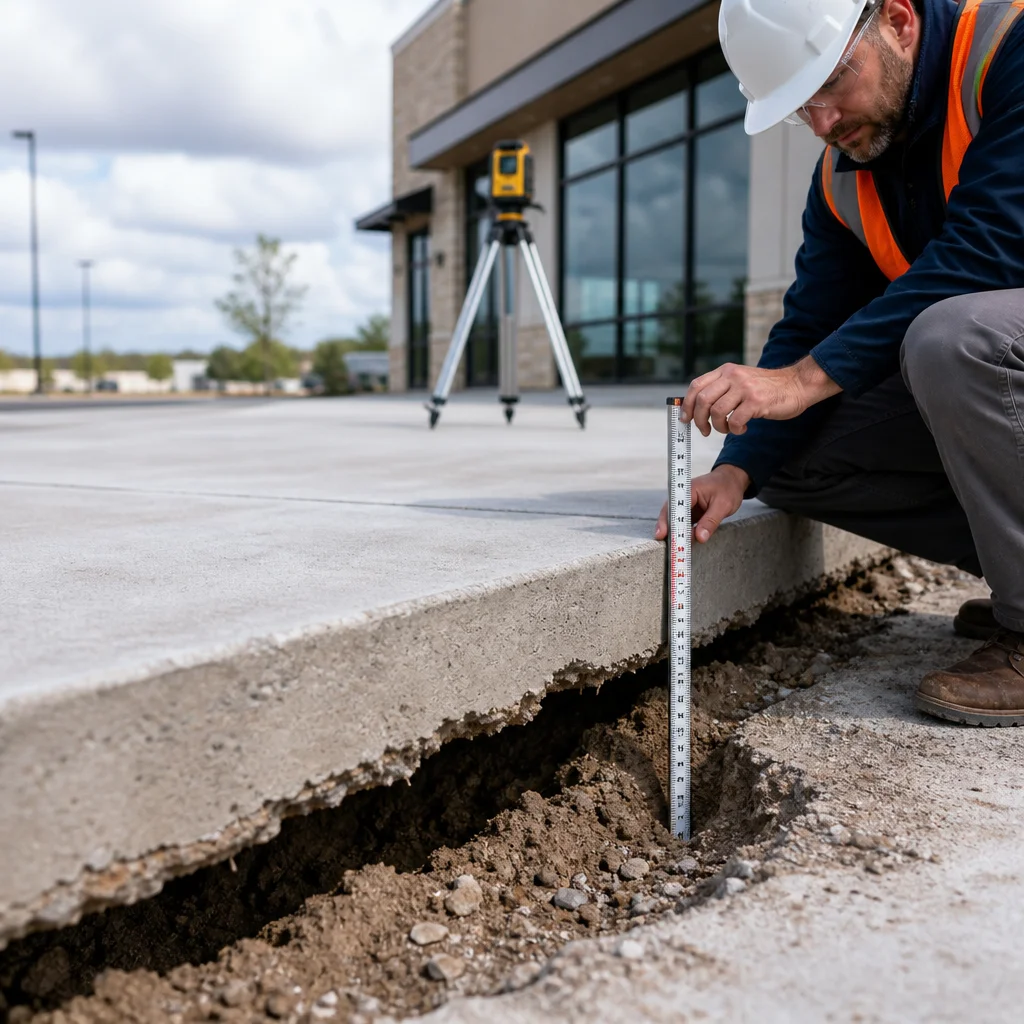
Lafayette experiences all three, especially during spring flooding and heavy summer storms. We regularly inspect foundations that have settled a quarter-inch to three-quarters of an inch over just 18 months of seasonal water exposure. Once you can see the settling with your eyes, the underlying damage is already substantial.
The soil beneath most Lafayette properties contains clay and silt, which absorb water aggressively. When saturated, these soils lose bearing capacity quickly. Concrete slabs that rest on poorly prepared or inadequately drained bases sink into this softened ground, and there’s no way to reverse the process without professional intervention.
Action takeaway: If you’re buying or managing a Lafayette property, request soil composition data and historical rainfall records. Understanding your site’s flood risk is step one of prevention strategy.
DIY Settling Prevention Methods and Their Limitations
Property owners often attempt four common DIY approaches: surface sealing, perimeter trenching, external drainage installation, and self-monitoring. Each has value for minor maintenance, but none address commercial-grade slab settling.
Surface sealing with concrete sealant feels productive. You clean the surface, apply a quality sealant, and tell yourself you’re protecting the foundation. In reality, surface sealants only prevent water from entering through the top of the slab. They do nothing to address water already present beneath the concrete or water approaching from the sides. If your settling problem involves subsurface water migration, sealing the top is like applying band-aids to a broken leg.
Perimeter trenching (digging a ditch around your foundation) sounds logical but requires knowing the correct depth, slope angle, and drainage pathway. Most DIY trenching creates channels that either clog with leaves and debris within months or direct water toward the foundation rather than away from it. We’ve recovered from several DIY trench disasters where improper grading actually accelerated settling by concentrating water flow directly under the slab.
Self-monitoring involves checking for new cracks quarterly or annually. This catches problems late. By the time cracks are visible enough for DIY homeowners to spot, the slab has already moved significantly. Professional monitoring uses precision instruments that detect micro-movements before visible damage appears, buying you months or years of advance notice.
External drainage pipes installed without professional site analysis often fail because they don’t account for soil composition, water table depth, or local hydrology. You might spend $800 on materials and labor only to have water find a path that bypasses your pipe entirely.
Action takeaway: DIY prevention delays problems rather than preventing them. Allocate your DIY energy toward maintenance tasks like gutter cleaning and downspout extension; reserve foundation protection for licensed professionals.
Our Professional Stabilization Approach and Proven Results
We deploy three integrated strategies that DIY methods cannot replicate: soil stabilization, slab lifting and re-leveling, and permanent subsurface protection.
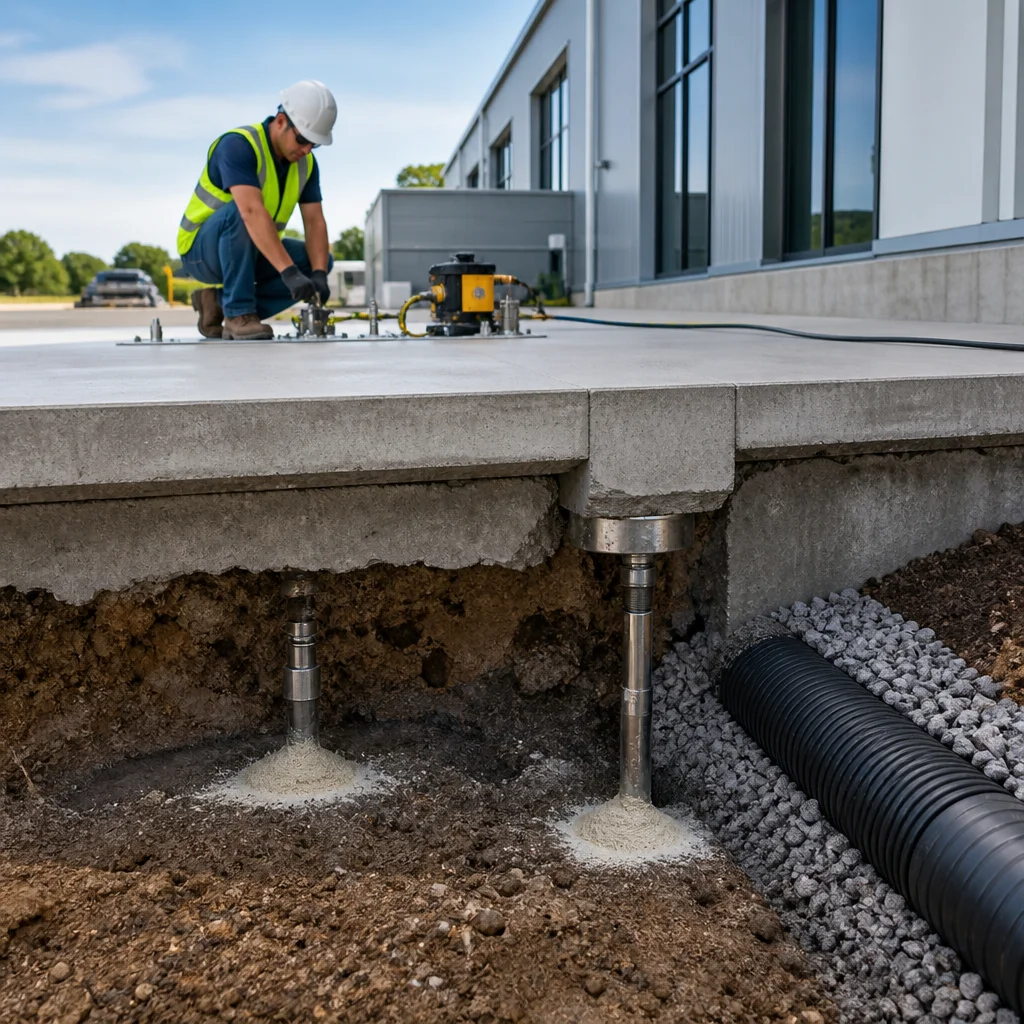
Soil stabilization involves injecting specialized compounds beneath the slab to restore bearing capacity. These compounds either fill voids created by erosion or chemically change soil properties so water cannot destabilize them further. We use polyurethane foam injection for speed and precision or micro-cement for deeper penetration, depending on site conditions. This literally rebuilds the foundation that concrete rests on, rather than just sealing the surface.
Slab lifting re-levels concrete that has already settled, restoring proper drainage and weight distribution. We use controlled pressure and specialized lifting equipment to raise sunken sections back to their original position, then inject stabilization compounds to permanently support them there. This isn’t a temporary fix; properly performed slab lifting lasts decades because the underlying problem (weak soil) is simultaneously addressed.
Subsurface protection systems include French drain installation at proper depth and slope, sump pump placement with backup power, and vapor barriers beneath slabs to prevent moisture wicking. We design these systems based on soil analysis and site hydrology, not guesswork. Every drain we install is sloped to actual drainage points, verified with laser levels and tested under water load before we consider the job complete.
Our Lafayette clients have experienced zero additional settling after professional stabilization, with the oldest completed projects now five years into observation. One commercial property owner documented settling of 0.75 inches before our intervention; post-treatment monitoring shows no measurable movement over three years.
Action takeaway: Get professional soil testing before committing to any prevention strategy. Understand your specific risk factors, then match them with targeted solutions.
Drainage Solutions: DIY vs Professional Installation
Proper drainage is non-negotiable for Lafayette properties, but drainage design requires understanding local water tables, seasonal patterns, and soil behavior.
DIY drainage typically involves surface gutters and downspout extensions. These handle rainfall runoff well during normal storms but provide zero protection against high water table rise or groundwater intrusion. Water rising from below the slab won’t be affected by surface drainage; it needs subsurface solutions.
Professional subsurface drainage works like this: we install perforated drain pipe at the footing level, below the water table but above the stable, competent soil layer. This captures groundwater before it reaches your foundation and directs it to a daylight outlet or sump system. The pipe is wrapped in filter fabric to prevent soil migration, then surrounded by clean gravel for water movement. This system functions continuously and requires no maintenance because water flows downhill through it by gravity.
For commercial properties with large footprints, we sometimes design interior sump systems that collect water beneath the slab, then pump it away during wet seasons. This is invisible but highly effective, providing real-time protection without visible exterior changes.
The cost difference is significant initially. A professional subsurface drain system might cost $3,000 to $8,000 depending on property size and soil conditions. A DIY approach with gutters and extensions costs $400 to $800. But the DIY system fails to prevent settling, while the professional system does. When settling repair costs $10,000 to $25,000, the drainage investment becomes obviously wise.
Action takeaway: Request a site drainage evaluation before deciding between DIY and professional solutions. Most property owners choose professional installation once they understand the cost of settling damage.
Foundation Monitoring and Early Detection Comparison
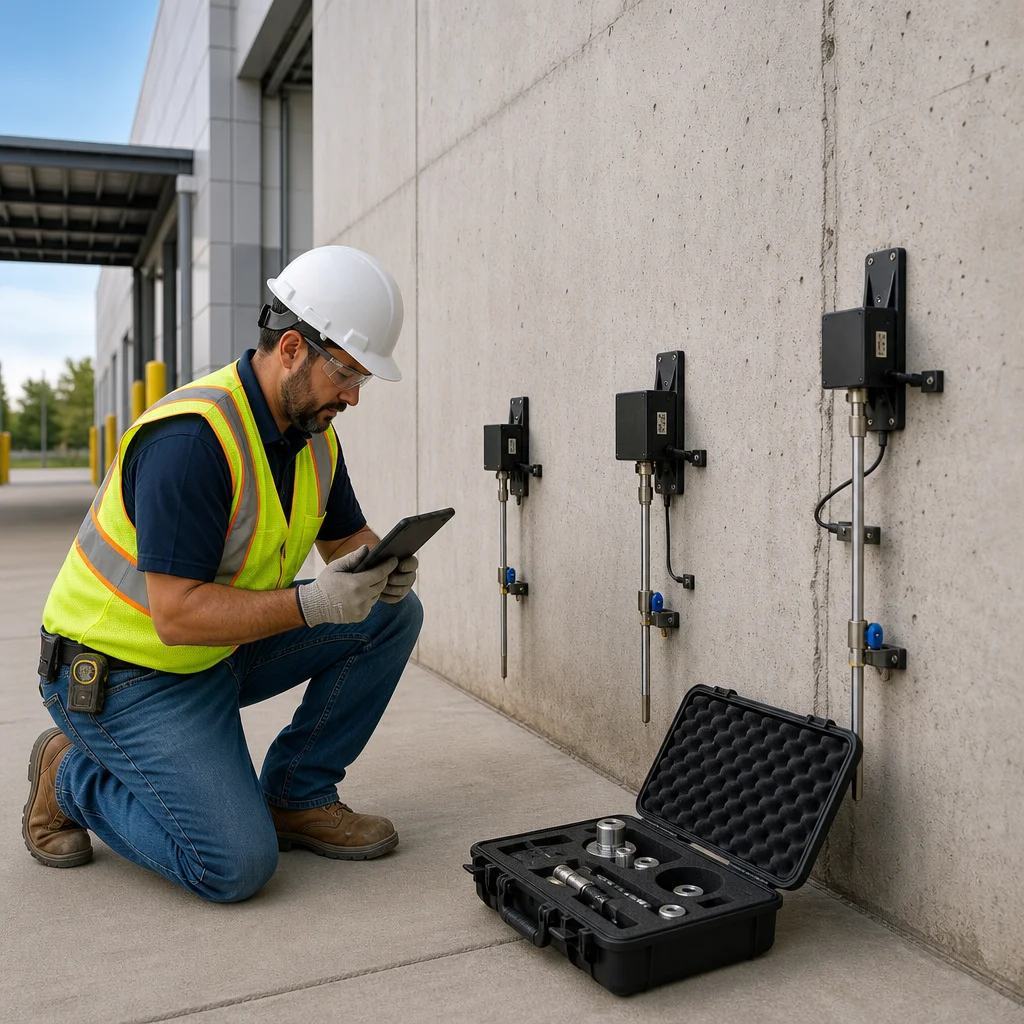
DIY monitoring relies on visual inspection and homeowner attention. Professional monitoring uses instruments that detect movement at 1/32-inch precision, catching problems long before they’re visible.
We install crack monitors on existing cracks to measure if they’re growing, static, or shrinking. We place elevation reference points on the slab and measure them with laser levels monthly or quarterly, detecting micro-settlements that indicate ongoing problems. For serious risk situations, we use vibrating wire sensors that transmit data wirelessly, alerting property owners to changes in real-time.
This technology costs $300 to $1,500 depending on the monitoring scope, but it provides irreplaceable early warning. A property owner who catches settling at 0.1 inches can address it for $2,000 to $4,000. The same problem caught at 0.75 inches costs $12,000 to $18,000. Early detection directly translates to dramatic cost savings.
Most DIY homeowners don’t notice settling until they see cracks or feel doors sticking. By that point, they’re already in the expensive repair territory. Professional monitoring shifts you from reactive (responding to damage) to proactive (preventing damage).
Action takeaway: If your property has any history of foundation issues or sits in a high-risk flood zone, invest in quarterly professional monitoring. The early warning you gain is worth far more than the monitoring cost.
Long-Term Cost Effectiveness of Professional Prevention
The math on professional stabilization is compelling. Here’s the typical scenario: a commercial property without protection experiences visible settling within 3 to 5 years in Lafayette. Repair at that stage costs $12,000 to $25,000 and causes business disruption. With professional prevention (stabilization plus drainage plus monitoring), the property owner invests $4,000 to $7,000 upfront and experiences zero settling.
The payoff is immediate: you avoid the $12,000 to $25,000 repair cost. Beyond financial return, you preserve property value, maintain tenant confidence, and eliminate the liability exposure that settles properties carry.
For residential properties, the logic is identical but the timeline differs slightly. A home without protection might settle gradually over 8 to 12 years, with repair becoming urgent around year 10. By that point, you’re facing $15,000 to $30,000 in foundation repairs plus potential structural complications. Professional prevention installed in year 1 or 2 costs $3,500 to $6,000 and eliminates all that future expense.
Professional solutions also hold better resale value. A home with documented professional foundation stabilization, verified through monitoring records, actually attracts buyers because the foundation risk is eliminated. A home showing foundation cracks attracts lowball offers and inspection complications.
Insurance considerations matter too. Many policies charge higher premiums or impose restrictions for properties with foundation settling history. Prevention preserves your insurance status and rates.
Action takeaway: Calculate the cost of prevention plus 10 years of potential settling repairs, then compare it to prevention cost alone. The comparison should eliminate doubt about choosing professional stabilization.
Our Licensed Team’s Expertise in Lafayette Conditions
We’ve worked in Lafayette for years and understand the specific challenges our regional environment creates. Our team includes licensed concrete specialists who’ve completed university-level soil engineering coursework and hold current certifications in foundation stabilization and drainage system design.
We’re not general contractors; we’re concrete and foundation specialists. This focus means we stay current with the latest stabilization technologies, understand local soil composition variations, and recognize early warning signs that generalists miss. Our crew has completed over 200 foundation stabilization projects in Lafayette and neighboring areas, giving us deep empirical knowledge about what works in our specific climate and soil conditions.
We also maintain relationships with local soil engineers and hydrologists. When a property presents unusual conditions, we bring in specialists for consultation rather than guessing. This network approach ensures every solution is optimized for the actual site conditions, not a one-size-fits-all approach.
Our team carries full licensing and insurance, and we’re bonded for all work we perform. This protects you legally and financially, a protection DIY approaches and non-licensed contractors cannot offer.
Action takeaway: When you contact a foundation specialist, ask about their specific experience with your property type and local conditions. Expertise matters.
Why Property Owners Choose Professional Solutions Over DIY
After exploring options, property owners consistently choose professional solutions for one core reason: they work reliably while DIY approaches fail unpredictably.
A property owner who invests in DIY prevention spends $500 to $1,500 and hopes the problem doesn’t return. A property owner who invests in professional stabilization spends $4,000 to $7,000 and knows it won’t return because the underlying cause has been addressed. The difference between hoping and knowing is worth the investment.
Property owners also recognize that settling problems compound rapidly. A small settlement becomes a structural problem within months. A structural problem becomes a safety issue within years. Once settling accelerates, repair costs and operational disruption explode. Professional prevention stops the cascade before it starts.
Beyond financial logic, property owners value peace of mind. Knowing your foundation is stable, monitored, and protected eliminates ongoing worry. You sleep better, manage your property more confidently, and make decisions from a position of knowledge rather than anxiety.
Commercial property managers choose professional solutions because liability exposure makes DIY unacceptable. If a foundation problem causes tenant injury or property damage and the manager failed to address settling despite knowing about it, liability follows. Professional prevention eliminates this risk through documented assessment and addressed solutions.
Action takeaway: Stop treating foundation protection as optional. Approach it as insurance: you pay now to avoid catastrophic costs later.
Conkrete Workz LLC: Your Complete Slab Protection Partner
We provide everything your property needs for complete slab protection: professional assessment, targeted stabilization, proper drainage installation, ongoing monitoring, and warranty-backed solutions.
Our process starts with detailed site evaluation. We analyze soil composition, water table conditions, drainage patterns, and existing settling. This assessment reveals exactly what your property requires, ensuring you never pay for unnecessary work or miss critical protection measures.
From there, we design a customized stabilization and prevention plan. Whether your property needs soil injection, slab lifting, subsurface drainage, or simply comprehensive monitoring, we size the solution to your actual risk. We provide transparent estimates with no hidden fees and timelines that fit your schedule.
Once work is complete, we don’t disappear. We establish monitoring programs that track your foundation’s performance, catching any issues before they escalate. This ongoing relationship means your property stays protected as environmental conditions change and seasons shift.
Our warranty covers the work we perform, backed by our commitment to do it right. We’re confident in our solutions because we’ve proven them repeatedly across Lafayette properties.
Contact us for a free no-obligation estimate on your property. We’ll assess your specific settling risks, explain exactly what your foundation needs, and provide a plan you can trust.
Frequently Asked Questions (FAQ)
What makes professional slab stabilization better than DIY settling prevention methods?
We use specialized equipment and techniques tailored to Lafayette’s unique soil and flood conditions that DIY methods simply can’t match. Our licensed team conducts thorough site assessments to identify the root causes of settling, then implements targeted solutions like underpinning or mud jacking rather than temporary fixes. We also monitor your foundation over time to catch issues before they become expensive problems.
How does Lafayette’s flood-prone environment affect concrete settling?
We’ve seen firsthand how water saturation weakens soil support beneath slabs, causing uneven settling that worsens each rainy season. Our drainage solutions address this core issue by directing water away from foundations rather than just treating the symptoms. Without proper protection, even new concrete will eventually settle unevenly in our climate.
Will professional slab stabilization save us money compared to repeated repairs?
We’ve found that investing in professional stabilization upfront costs significantly less than multiple repair cycles over the years. When we prevent settling early, you avoid foundation damage spreading to your structure, which keeps your long-term costs manageable. Many property owners initially see professional work as expensive until they realize how much repeated patching and foundation repairs would have cost them.